 Verified
6-Day Mindfulness Meditation in Pokhara
Pokhara · Sarangkot6 days
from $440deposit $66
Flexible cancellation
Guided programs, silent retreats, and Buddhist courses in Nepal: every paid retreat verified in person. We also point you to donation-based Vipassana courses, on which we take no commission, so you can choose the format that fits you.
4 verified retreats, each checked in person.
All retreat categoriesNo verified retreats match those filters yet. We add operators every week. Loosen a filter, or tell us what you're after and we'll go find it.
Help me choose (free, human, 24h)Nepal runs the full range, from beginner-friendly guided programs to structured silent retreats and Tibetan-tradition Buddhist courses. Some of the country's deepest practice is donation-based, and we list it commission-free alongside verified paid retreats, so you can choose the format that fits you rather than the one that pays us.
| Format | Cost band | Support level |
|---|---|---|
| Guided (paid) | $390–1,200 | Daily instruction, teacher feedback |
| Silent (paid) | $450–1,200 | Structured noble silence with a teacher on hand |
| Buddhist course | $400–900 | Tibetan-tradition study near Boudha |
| Vipassana (donation) | $0 / donation | Fixed 10-day format; book directly |
The paid formats give you dates you choose, a room of your own, and a teacher you can turn to; the donation-based path gives you a fixed structure with deep roots. Neither is better: they answer different questions, and the sections below help you tell which one you are asking.
Both are legitimate, first-class choices. A donation-based 10-day Vipassana course offers depth and a fixed structure at no fixed cost; a paid retreat offers a teacher on call, your own room, and flexible dates. Our complete guide to Vipassana in Nepal covers the donation-based path honestly. We take no commission on it.
| What matters to you | Paid retreat | Donation-based course |
|---|---|---|
| Teacher access | On call through the program | Group guidance, set format |
| Room | Private option available | Simple, usually shared |
| Dates | You choose from the calendar | Fixed course dates |
| Structure | Flexible, teacher-shaped | Unchanging 10-day discipline |
| Cost | All-in, shown up front | Donation after you complete it |
| Booking | Request here, deposit after confirmation | Apply directly with the centre |
If a fixed structure and letting go of choices is exactly what you are looking for, a donation-based course may serve you better than anything we could sell you, and we will say so. Recommending it when it fits is part of how we earn your trust for the times a supported paid retreat is the right call.
Three questions sort most of it: how much experience you have, how much silence you want, and which tradition speaks to you. Work through them and the format usually chooses itself.
If you have never meditated formally, a guided paid retreat with daily instruction is the gentler start: teachers introduce technique step by step and answer questions as they come up. A full 10-day silent course is demanding for a first sit; it rewards people who already have some practice or a clear reason to go deep.
Guided programs mix instruction, discussion, and practice. Silent retreats in Nepal hold periods of noble silence so nothing sits between you and the practice. Many Nepal centres blend the two across a single program, easing you into longer quiet stretches rather than dropping you into ten days of it.
Broadly, you will meet secular mindfulness and breath-and-body practice, and Tibetan Buddhist courses with analytical and stabilising methods taught near Boudha. If the Goenka-tradition 10-day format is what draws you, our complete guide to Vipassana in Nepal explains it without any pressure to book.
Practice clusters in a few places, and where you sit shapes the days as much as the format does.
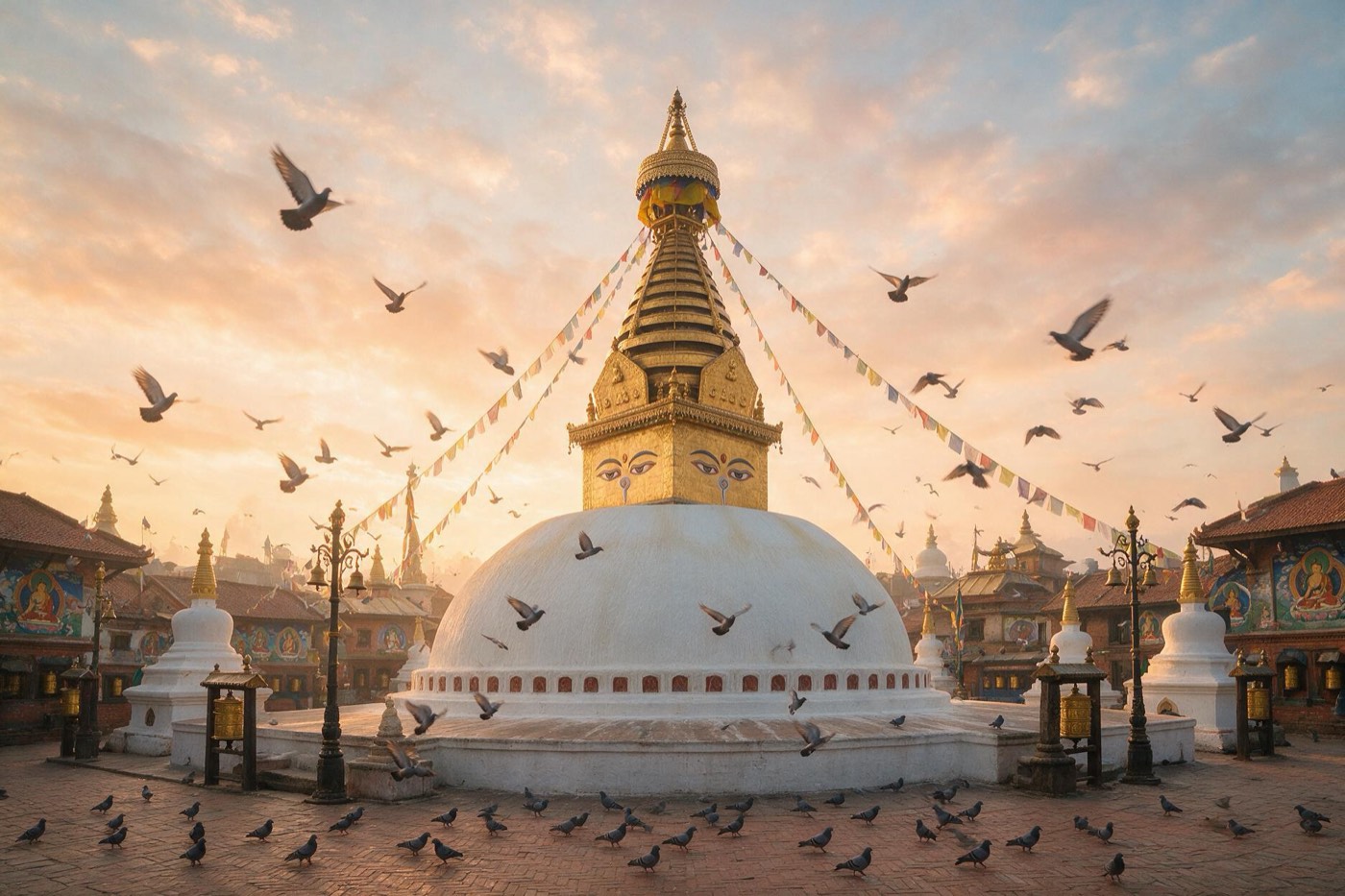
Boudha, around the great stupa in Kathmandu, is the valley's Buddhist heart: monasteries, study centres, and the steady turn of pilgrims circling the dome. It suits anyone drawn to the Tibetan tradition or who wants monasteries within walking distance. Pharping, in the quiet hills south of the valley, is a long-standing retreat area with caves and small centres, calmer than the city and good for silent practice. The donation-based Dhamma Shringa Vipassana centre sits in the Budhanilkantha hills above Kathmandu; it is booked directly rather than through us. Compare verified programs across the valley on the Kathmandu meditation hub.
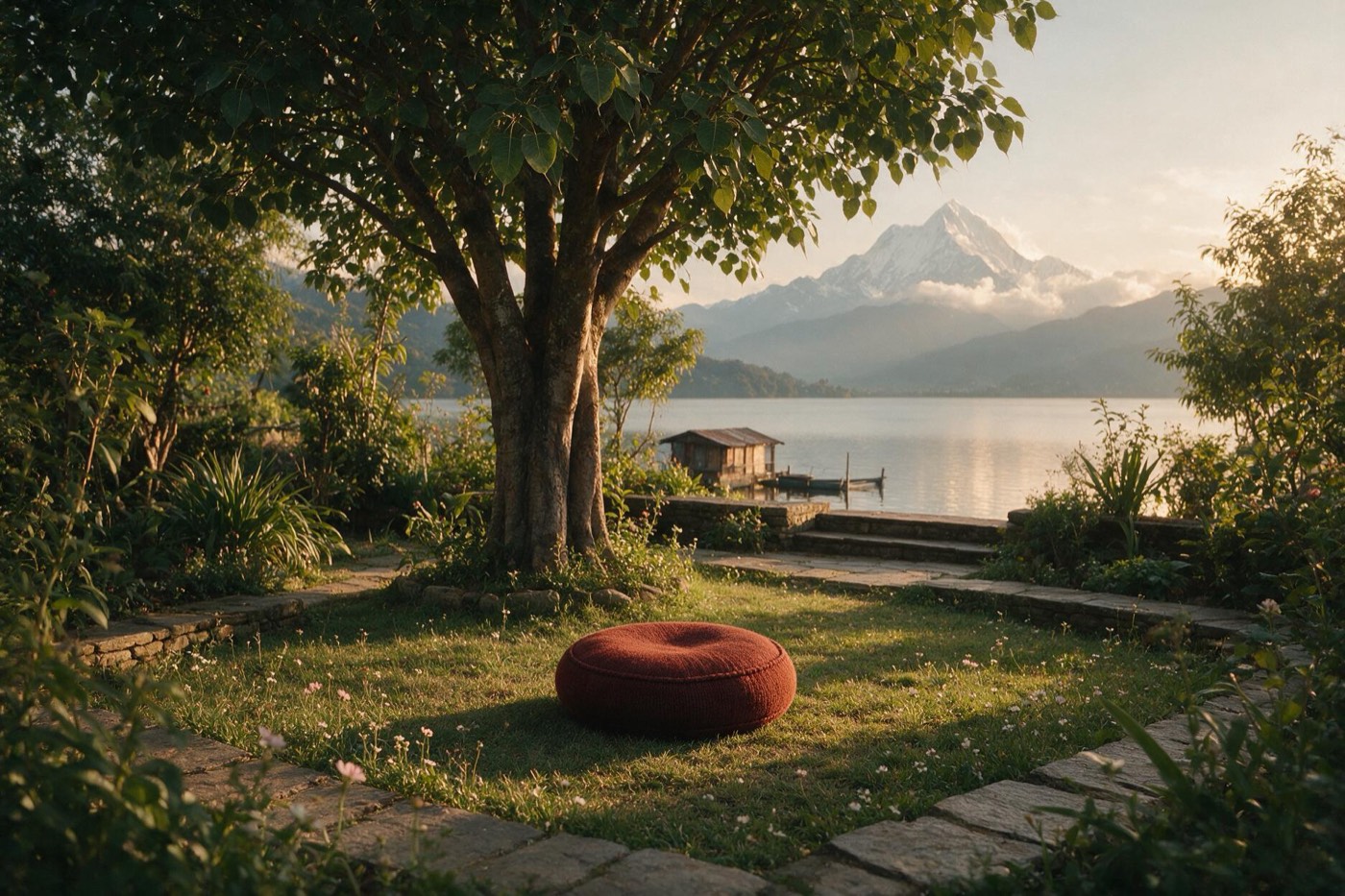
Pokhara offers a softer setting: lakeside calm, mountain views, and small groups that often pair meditation with gentle yoga. It is an easy place to begin and the natural base if you want to walk in the Annapurna foothills afterwards. See what is running on the Pokhara meditation hub.
Days are simpler than home and more structured. A typical schedule wakes early, moves between sitting and walking practice with breaks and meals, and closes with an evening session or a talk. The exact rhythm varies by centre and format, but it tends to look like this:
| Time | A typical day |
|---|---|
| Early morning | Wake, first seated meditation |
| Breakfast | Simple vegetarian meal |
| Morning | Guided sittings with walking meditation between |
| Midday | Main meal, then rest |
| Afternoon | Further practice, sometimes a teacher talk |
| Evening | Closing session; lights out early |
On silent retreats you will hold noble silence: no talking, eye contact, or gestures with other participants, though you can still speak with the teacher. It sounds daunting and is often the part people come to value most: with the small talk of an ordinary day removed, attention has room to settle.
A little planning makes the first days easier. Before you go:
When you are ready to reserve a supported paid retreat, how booking works here explains the deposit: you pay nothing until the centre confirms your dates.
Tell us what you need and a person (not a bot) replies on WhatsApp within 24 hours.
Help me choose (free, human, 24h)